
What is Schlieren ?
Table of Contents
What is Schlieren
Schlieren is an optical visualization technique developed in the 19th century. Even if a transparent gas is ejected into the atmosphere, the gas itself cannot be seen directly by the human eye. However, if the density of the ejected gas is different from that of the air, the light passing through that part is refracted, resulting in a difference in brightness.
If this refractive index becomes extremely large, it can be seen with the naked eye. For example, the heat haze seen in summer is caused by this phenomenon. The optical visualization technique of fluids that applies this phenomenon is called the Schlieren method. Schlieren comes from the German word for "mottled".
Conventional Schlieren methods use a light source, multiple lenses, convex mirrors that require extremely high precision, and light beam cutting filters such as knife edges.
Using these devices, the subtle differences that appear in the light beam appear as large differences in the image, and this has been established as a general technique for visualizing distortions in air and water caused by important physical parameters such as temperature, density, pressure, and bonding.
Conventional Schlieren devices use parallel light created by mirrors and lenses, which limits the measurement area and places various restrictions on wide-area measurement.
In addition, various restrictions arise, such as the installation and adjustment of the optical system and the light source, and setting it up requires an enormous amount of time and skilled techniques.
New Schlieren System
First, a special pattern (or a special pattern printed on physical paper, etc.) projected from a digital projector or monitor is used as the background. Next, the object to be measured is photographed with a Digital camera (or a high-speed camera: existing cameras can also be used).
At this time, the focus of the lens on the camera is set on the background pattern, not the object.
If the refractive index in the atmosphere is constant (no density gradient), there will be no change in the background pattern image photographed by the camera.If high and low temperature air currents, gases with significantly different components from the atmosphere, or shock waves occur in the measurement environment, they will cause a change in the refractive index in the measurement environment and create a state with a large density gradient.
Therefore, if there is an area with a large density gradient, the background pattern will be changed.By comparing the pattern image before the change with the pattern image after the change, a Schlieren image can be obtained. The analysis is performed using Koncerto II-DSS software equipped with a dedicated algorithm.
The newly developed dedicated algorithm and measurement device are very sensitive, and it is possible to observe the warm air rising from the palm of an outstretched hand.
This new Schlieren System has a very large practical advantage over most previous Schlieren systems.
First of all, the new Schlieren System only requires three items: 1) a dedicated background pattern unit, 2) a dedicated camera (existing cameras can also be used), and 3) dedicated software (PC).
Since it uses a digital projector or display, it is possible to build a variety of systems depending on the scale of the measurement,making it possible to observe from under a microscope to on a meter-scale.
the equipment configuration is simple, making Schlieren observation very easy.
In addition, the price is not high, and if you use your own camera (or high-speed camera), you can perform Schlieren measurements by purchasing only the software.
New Schlieren System: What is Digital Schlieren?
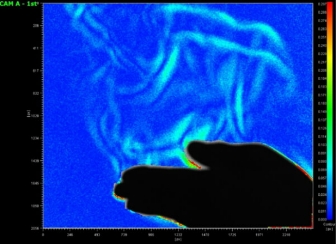
Digital Schlieren is one of the so-called BOS (Background Oriented Schlieren) methods that optically visualize density gradients occurring in space.
Compared to the conventional schlieren method, there are very few optical elements, and schlieren images can be easily acquired. Unlike normal foreign matter inspection systems, it is possible to visualize and image objects and phenomena that cannot be visualized.
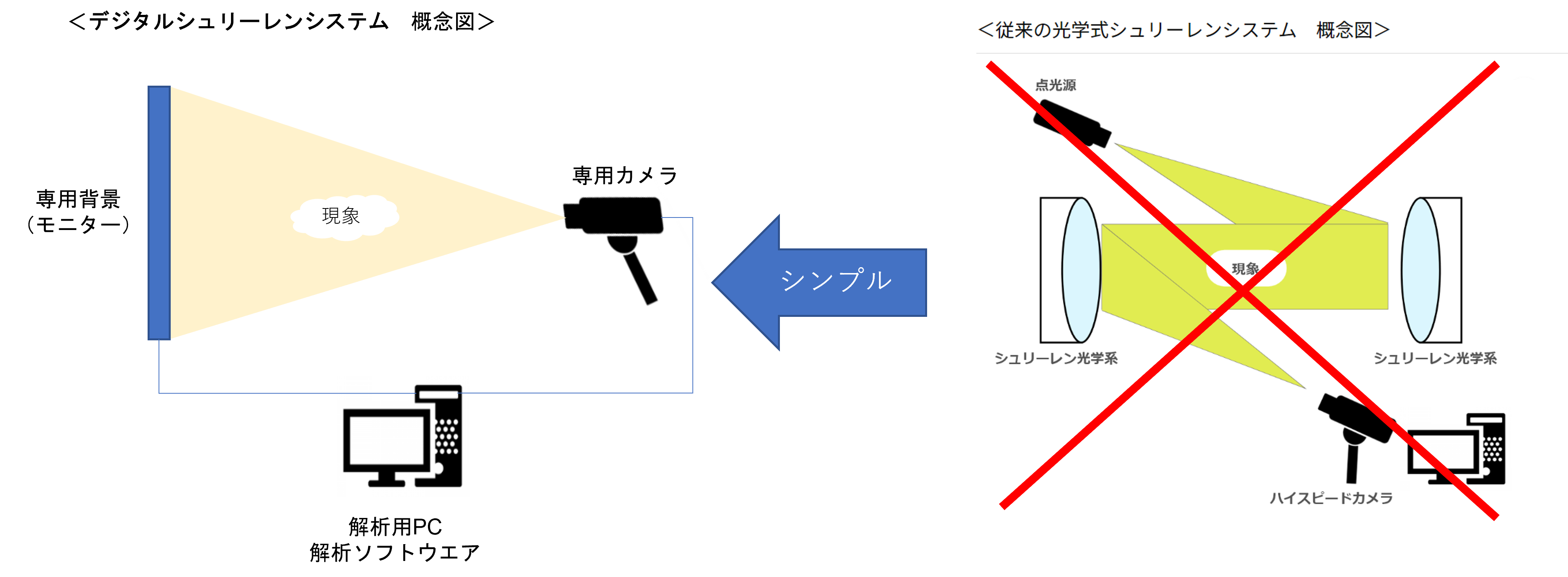
The Digital Schlieren System is a revolutionary system that can easily capture wide-area Schlieren images without the need for complex equipment configurations or optical adjustments.
Measurement order
① A camera is placed facing the subject, and a dedicated background is placed on the opposite side.
② A base image is obtained in the raw state before the phenomenon occurs (when there is no density gradient).
③ Once the phenomenon occurs, the required number of images are taken at the desired frequency.
④ Once all the data has been captured, the difference from the base image is analyzed using analysis software to calculate a Schlieren image.